

.png)
.jpg)
- Your AI deployment's ceiling is set by what you can measure, and that's a business constraint as much as a safety one.
- Companies use AI for drafting and internal research, then stop, because nobody can prove what a customer-facing or revenue-touching system will say.
- If a human reviews every AI output, the AI saved you nothing. You replaced writing with reading, and reading someone else's work often takes nearly as long.
- Five checkable gaps, stale knowledge, missing context, synthesis errors, permission leakage, and silent drift, hold the ceiling down, and each has its own fix.
- Raising the ceiling takes about 90 days for a mid-market team: inventory, logging, one named owner, one eval loop, one review cadence.
- Compliance is mostly handled already by your tech stack. Whether your AI's answers are correct is a separate job, and it's the one this page is about.
A typical 200-person company is running three AI systems: a drafting assistant for marketing, a research tool for sales, and a meeting-notes summarizer. All three are useful. All three are also confined to low-stakes, internal work, and nobody made a conscious decision to keep them there. That's where AI adoption stalls: the moment a workflow reaches anything a customer sees or a dollar touches. Nobody can prove what the system will say, so nobody will risk it saying that to a customer. What you can measure about a task sets your deployment's ceiling, and that ceiling decides your cost structure, your win rate, and how fast you can grow. It's also why we're seeing more companies bring in outside help for this one specific, technical job: building the measurement itself, separate from broader AI strategy work.
What is AI governance?
AI governance is the set of practices a company uses to control how it builds, deploys, and monitors AI systems, so they behave as intended and someone is accountable when they don't. It covers two different jobs that are easy to conflate. Policy-level governance asks whether a company is allowed to use a given AI system at all: data privacy, licensing, regulatory exposure. Output governance asks a narrower question: whether what that system produces can actually be trusted to act on.
For an SMB or mid-market company already running AI internally, output governance is usually the more urgent of the two. A system can be fully permitted to operate and still be too unproven to hand a customer-facing answer to. This page focuses on output governance specifically, because it carries the bigger near-term business consequences and it's the part almost no team this size has built a real practice around yet.
In practice, output governance means three things: knowing your current error rate on a given task, deciding which tasks are safe to run without a human checking every output, and naming someone accountable for both. The rest of this page works through what limits that measurement today, a framework for deciding where review belongs, and a 90-day plan for building it.
AI stops being valuable wherever it can’t be proved right.
Most companies we've seen hit the same wall, at the same layer. AI drafts a first version, summarizes a document, or answers an internal question, and it's good at all three. It doesn't get near sending a quote, resolving a support ticket unreviewed, or making a call a customer will act on. Current models are good enough for a lot of that work already. What's missing is proof: nobody in the room can say, with a number attached, how often the system is right on that task, so the rational move is keeping it away from anything expensive to get wrong.
That's rational, and expensive to leave in place. The company banks the small, safe gain, faster drafts, quicker research, and never reaches the larger one: a workflow running with less headcount attached to it. In McKinsey's 2026 AI Trust Maturity survey of roughly 500 organizations, leaders with direct responsibility for AI governance and investment decisions named inaccuracy their top AI risk at 74%, on par with cybersecurity at 72%. That makes inaccuracy the most commonly cited risk, narrowly ahead of cybersecurity.
The ceiling is set by what you can measure about a task, and it moves the moment you can measure more of it. A workflow you can't put a number on stays manual. The same workflow, with a known error rate on a known category of question, becomes one you can start automating with a real dollar figure behind the decision.
If someone needs to check every AI output, you save nothing
MIT NANDA's State of AI in Business 2025 report, based on 52 structured interviews, a survey of 153 senior leaders, and an analysis of more than 300 public AI initiatives, found that 95% of organizations investing in generative AI are seeing zero measurable return. The report's own explanation centers on systems that don't retain feedback or improve with use. Our read, from watching these pilots run again and again is that a second, more mundane mechanism is usually also at work, separate from anything the report itself measured.
If a human reviews every output before it ships, the AI adds a step instead of removing one. Checking a draft against the source, correcting it, and approving it takes time, often close to what writing it from scratch would have. The pilot can succeed, the tool works, people like it, and the cost line still never moves, because the person who used to write the thing is now reading someone else's version of it instead. That's a real improvement in draft quality, and it falls well short of the labor reduction anyone budgeted for.
The fix is knowing precisely which categories of output are safe to stop checking, so review time drops where it's earned and stays where it hasn't. The human stays in the loop; the review gets targeted instead of a blanket. That's a measurement problem before anything else, and it's the difference between a pilot that feels good and one that shows up in the numbers.
Five reasons AI gets it wrong
This is the part usually skipped in favor of talking about risk in the abstract. These are five common, checkable gaps. Each one caps what you can safely automate, and each is fixed with a technical change to the system.
Stale knowledge. The AI's answer was correct when the source document was current, and nobody updated it when the source changed: a pricing policy from March, still quoted in August. This caps automation on anything touching pricing, terms, or policy. Fix: a source document with an owner and a refresh cadence.
Missing context. The AI never had a path to the information it needed, so it answered from general knowledge instead of yours. This is a retrieval coverage problem: no instruction fixes a system that was never connected to the document with the answer. Fix: expand what the system can retrieve from.
Confident synthesis error. The AI had the right document and still got the summary wrong, a misstated figure, a dropped caveat, two sections combined into a claim neither makes alone. Vectara's HHEM hallucination leaderboard, evaluating models on article summarization across more than 7,700 articles, found even the best-performing model in its November 2025 release still hallucinated a summary 3.3% of the time, with several widely used models exceeding 10%, on a task where the source text was supplied directly. Retrieval doesn't fix this one: the model had the facts and still got the synthesis wrong. This is the category that keeps spot-checked review from ever fully going away. Fix: require answers to cite the specific passage they're drawn from, and run a sampled accuracy check on summaries specifically, not just on retrieval
Permission leakage. The answer was correct, but it reached someone who shouldn't have seen it: a salary detail, an unreleased roadmap item, another customer's data. This caps deployment on anything spanning departments or access tiers. Fix: filtering at the retrieval layer, based on who's asking.
Silent drift. The vendor updated the underlying model, and behavior changed without anyone on your side deciding it should. An answer style or accuracy pattern that was fine last quarter isn't this quarter, and no launch-day checklist catches a change that happens after launch. Fix: ongoing monitoring against a fixed set of test questions, run on a schedule.
Once you can name which of the five is actually limiting a given workflow, you know exactly what to fix before you expand what that workflow is allowed to touch.
When is it safe to stop checking?
Most teams already added oversight, usually everywhere, which is how a pilot stops saving anyone time. The question that actually matters is what you can responsibly stop reviewing, decided on purpose using three factors: how expensive a wrong answer is, how reversible it is, and how much volume runs through it.
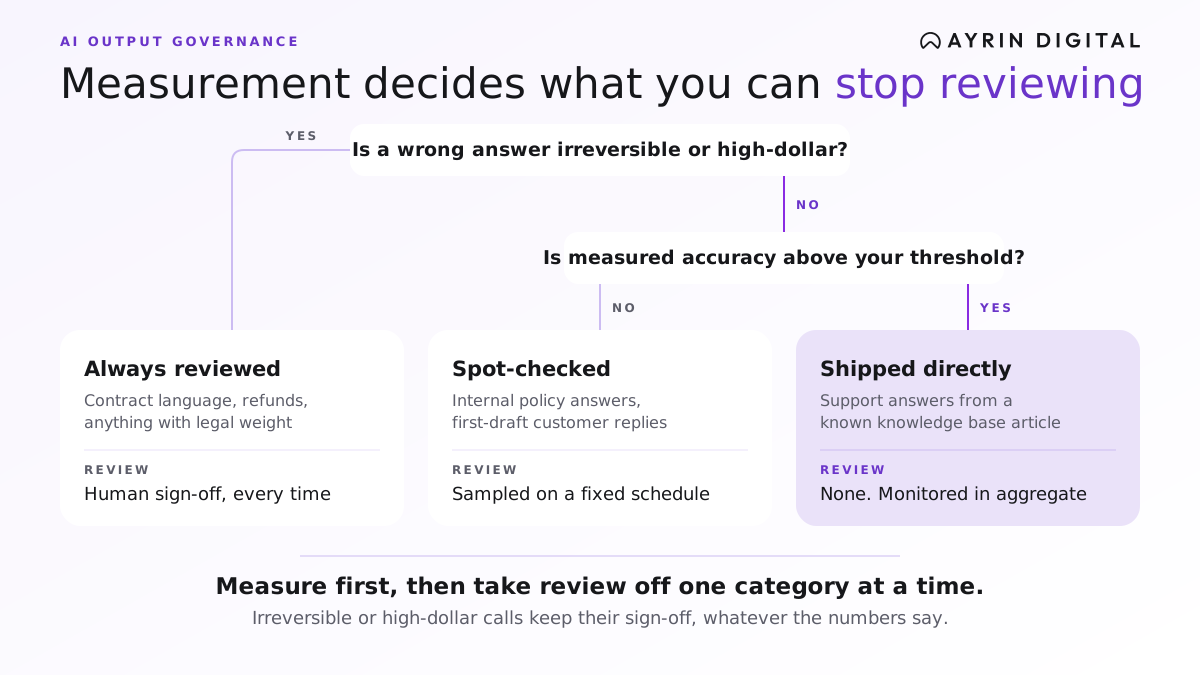
A support ticket answered from a knowledge base article with a known, low error rate on that question type can move to the bottom tier. A refund approval should always keep its human sign-off, no matter how good the system's numbers get, because the cost of being wrong once outweighs the savings of being right a thousand times. That's the exception worth stating plainly: measurement earns you the right to remove review on the categories where it's genuinely safe.
What it takes to raise the ceiling
This is deliberately small. A mid-market company without a dedicated AI governance hire can do all five of these in about 90 days, and going bigger than this list before you've done it once tends to produce a project that stalls instead of a habit that sticks.
- Inventory every AI system in active use. Include the ones a single team adopted informally. You can't measure what you haven't listed.
- Turn on logging for every system on the list. You can't compute an error rate without a record of what the system actually said.
- Name one accountable owner, not a committee. One person responsible for knowing whether the company's AI systems are telling the truth.
- Run one evaluation loop on your highest-stakes use case. Pick the single workflow where being wrong costs the most, and build a real, repeated accuracy check for it before touching anything else.
- Set one review cadence. A fixed, recurring check on accuracy and drift, scheduled from day one rather than left for a one-time launch review.
Small on purpose: a company that tries to do this for every AI system at once usually finishes none of it. A company that does it for one system and gets a real number out the other end has a template it can repeat.
What this changes about how the business runs
Three things shift once a company actually measures its AI output: how deals get won, what AI is allowed to touch, and who owns quality.
How deals get won is starting to include this. As more of what a vendor sells touches AI, we expect the buyer's question to shift from what the AI does to how the vendor knows it's right. Our read on where vendor evaluation is heading is that a company with a real measurement story will have a structural edge over one that just answers "we use GPT."
Whether AI stays an internal tool or becomes something you sell depends on this too. Trustworthy, measured output is what lets a company put AI in front of customers instead of only employees, and that's a product line a competitor without the same measurement discipline can't open. It compounds too: usage data from a live customer-facing system is exactly the feedback that keeps a system improving, feedback a system confined to internal drafting never gets.
It changes who owns quality. Quality used to be distributed: every person doing a piece of work was their own check on it. With AI in the loop, quality becomes a system property, and system properties need an owner. Almost no mid-market company has made that org chart change yet. There's no head of does-our-AI-tell-the-truth at most companies this size, and that organizational gap is the biggest single thing standing between a company and wider AI deployment.
Why accuracy slips after a few months
Governance that only covers launch day decays. These are the five ways it quietly comes apart once a system has been live for a while, and none of them show up in a pre-launch checklist.
What about compliance?
Compliance is a different, narrower job, and for most SMB and mid-market companies it's mostly already covered by the platform choices and vendor contracts you've made, plus a reasonable internal policy. NIST's AI Risk Management Framework and ISO/IEC 42001 are the two standards worth knowing by name if you want a formal reference point. What neither one answers is whether a specific answer your AI gave today was actually correct. That's a different question, and it's the one this page is about. We build the second thing. Colorado's original AI Act was repealed before it ever took effect, replaced by the narrower Automated Decision-Making Technology Act (signed May 2026, effective January 2027), and a December 2025 federal executive order is actively trying to preempt state AI laws in favor of one federal framework. None of that is settled, which is itself the point: build your governance around proving your AI is accurate, not around one law's specific requirements that holds up no matter which framework wins.



.png)