



- An AI agent reasons through a task and takes action on its own; traditional automation only executes fixed rules and stops at anything outside them.
- An AI agent is five layers, not one: guardrails, orchestration, model, memory, and integrations. A vendor supplies the model. The other four are yours.
- Building an AI agent that takes real actions costs $8,000 to $42,000; a multi-agent platform with its own data layer runs $25,000 to $128,000.
- 80% of organizations already report agents delivering measurable ROI, but integration (46%) and cost (43%) are still the top deployment barriers in 2026.
- Scope kills more of these projects than model choice does. Start with one workflow and one success metric, not a platform.
- Deterministic, rule-based processes that never change are usually cheaper and more reliable to automate the traditional way, not with an agent.
- Evaluate a build the same way you'd evaluate any vendor: what it's scoped to do, how it's supervised, and what "working" means before day one.
What is an AI agent?
An AI agent is a system built on a large language model that reasons through a task, decides what steps to take, and carries them out on its own, rather than only responding to a single prompt or following a fixed script. That is the practical difference from traditional automation and RPA: automation executes pre-defined rules and stops at anything outside them, while an agent makes its own decisions inside guardrails a team sets up front. Building one that works in production costs roughly $8,000 to $128,000 depending on scope, and the projects that succeed are the ones that define what "working" means before a single line of the system gets built.
OpenAI's own guidance for teams building agents defines one plainly: a system that can "independently accomplish tasks on your behalf". In practice, that means the system holds a goal, chooses from a set of tools or actions to reach it, and adjusts its next step based on what happens, without a person approving each individual move.
That autonomy is the entire distinction from older software categories. A script runs the same steps every time. A chatbot answers a question and stops. An agent can look at the result of its own last action and decide what to do next, inside limits a team defines up front (which systems it can touch, which actions need a human sign-off, and when it should stop and ask).
How are AI agents different from automation, RPA, and chatbots?
The difference is in who decides the next step. Traditional automation and RPA follow rules a person wrote and stop at anything those rules don't cover. A chatbot answers and stops there. An AI agent picks its own next step based on what just happened, and can act across systems to finish the task.
Anthropic's 2026 State of AI Agents Report frames the operational difference directly: agents "reason through problems, make decisions, and take action autonomously", handling everything from multi-step coding work to processes that span several teams. Traditional automation, by contrast, executes the steps it was configured for and stops the moment it hits something outside them, waiting for a person to take over.
What are the most common AI agent use cases?
The highest-volume AI agent deployments in 2026 are customer support, software development, internal documentation and reporting, security operations, and finance and compliance review.
Support and coding lead by volume, and for the same reason: both have a clear definition of a correct answer and an obvious human fallback when the agent gets it wrong. That is the pattern worth copying. The workflows that suit an agent are the ones where someone can tell, quickly, whether it did the job.
Published results from companies running agents in production give a sense of the ceiling. Novo Nordisk cut clinical documentation from ten weeks to ten minutes. eSentire compressed security threat analysis from five hours to seven minutes. Parcha reduced customer due diligence from three months to five minutes.
These are outcomes the companies reported to Anthropic, whose agents they run, so read them as the best case rather than the average. What they show is the shape of a good fit: high-volume work, a repeatable judgment call, and an output someone can check.
In the same survey, 80% of organizations reported agents delivering measurable economic returns and 88% expected that return to hold or grow. Worth holding alongside that: the survey ran among organizations already deploying agents, so it measures how it is going for the people who committed, not how often committing works out.
Note: These are vendor-published customer outcomes, not independently audited figures, so read them as the top of the range rather than the average. They are still useful, because they show what the ceiling looks like when the scoping is right.
What is an AI agent actually made of?
An AI agent is five things stacked inside each other: guardrails, orchestration, a model, memory, and the tools it can reach.
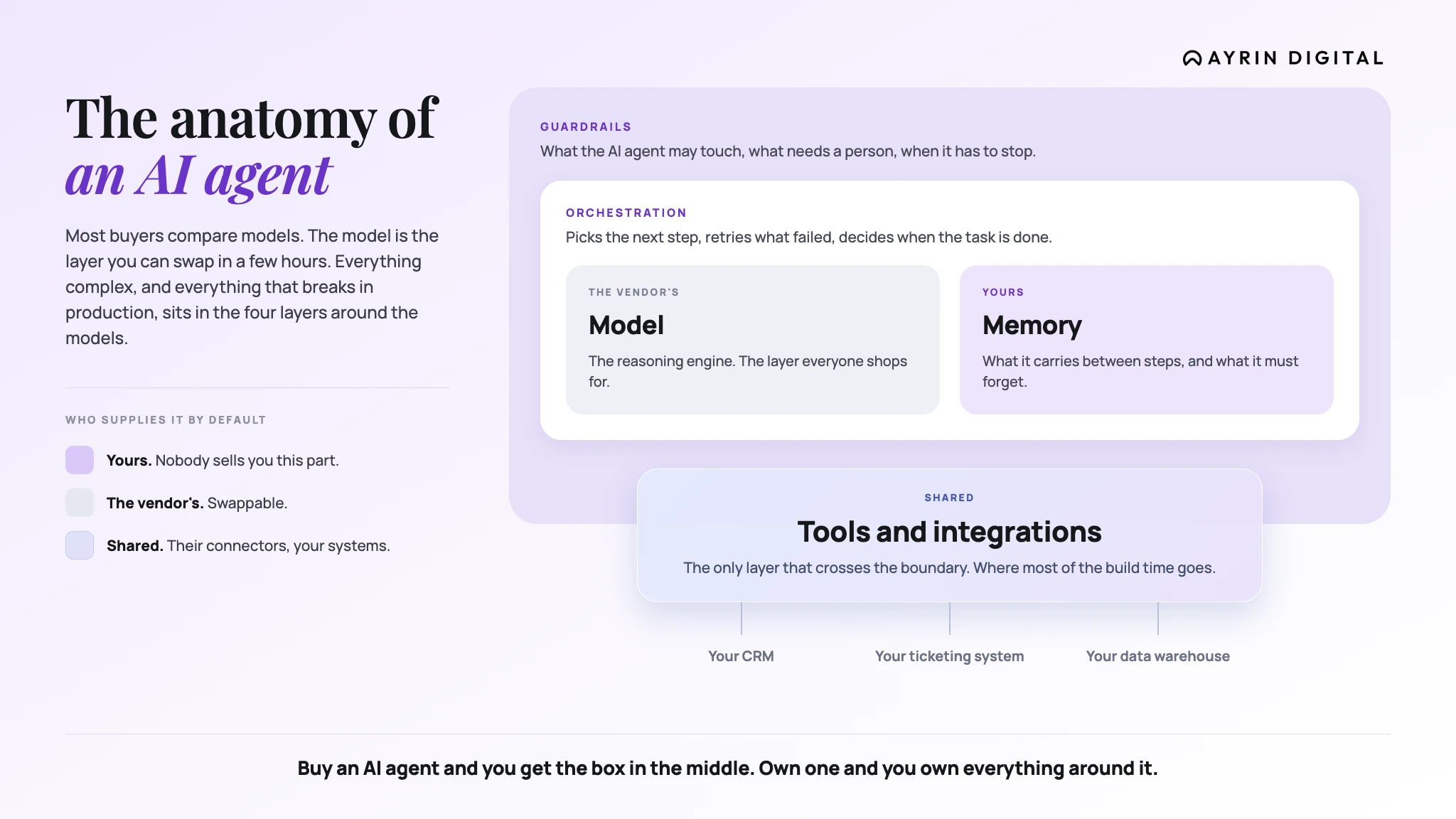
Only one of those layers is the model, and it is the one every buyer asks about first. Ask an agent vendor what you're getting and the answer is usually the model plus enough orchestration to run it. The rest is yours: what the agent is allowed to touch, what it remembers between runs, and every system it has to reach into to be useful.
This is why two quotes for the same workflow can differ by 5x. They are not pricing the same layers.
What breaks after an AI agent goes live
It’s important to remember that a demo fails visibly. Production fails quietly.
These problems don't show up in week one. They show up in month two, once the agent has run a few thousand times and nobody is watching it the way they watched the pilot. Each one sits in a specific layer, and each one has a control that would have caught it. The controls are not expensive. They are just much cheaper to build in than to add after something has already gone wrong.
Notice how little of this is about the model. Picking a better one fixes none of it.
This is also the honest argument for scoping a first build narrowly. Five layers of controls on one workflow is a normal amount of engineering. Five layers on four workflows at once is where the budget goes, and usually where the project stops.
How much does it cost to build an AI agent in 2026?
Cost scales with how many systems the agent has to touch and how expensive a wrong answer is, not with how sophisticated the underlying model is. Based on our own project-scoping analysis, informed by Clutch's verified client-reported benchmarks for custom software projects generally ($10,000–$49,000 typical range, $132,480 average, 13-month average timeline), here's how we size a first AI agent into two realistic tiers.
Automation tier: $8,000 to $42,000, 5 to 8 weeks.
One workflow, real actions, one or two integrations. A build lands at the bottom of this band when there's a single internal system with a clean API and data somebody already maintains. It lands at the top when the system is legacy, the data needs work first, or a formal security review is in scope.
Platform tier: $25,000 to $128,000, 10 to 16 weeks.
Multiple agents over a shared data layer, covering more than one workflow. Almost every project that reaches this tier got here by expanding scope mid-build, not by starting here on purpose.
Cost is also one of the two biggest reasons enterprises stall on AI agent projects: 43% of organizations cite implementation cost as a top barrier, second only to systems integration at 46%.
Note: These ranges come from our own scoping of AI agent and automation builds, sanity-checked against Clutch's client-reported benchmarks for custom software projects. They are directional, not a quote. AI agent pricing has no established public benchmark yet, so treat any specific figure you see elsewhere, including ours, as a starting point for a scoped conversation rather than a market rate.
Treat the bottom of each band as a floor. A quote well under it usually means the integration surface and the human review step haven't been scoped yet. That is the expensive outcome, not the cheap one.
What makes one AI agent build cost more than another?
Four things account for most of the spread, and the model is not one of them.
- How many systems it has to touch. One internal system with a clean API sits at the bottom of the band. Three systems, two of them legacy, sits at the top or past it.
- How clean the data is. An agent making decisions on incomplete or unstructured data needs the data work done first. That work is often bigger than the agent build.
- What a wrong answer costs. A drafting assistant needs light review. An agent that moves money or edits a customer record needs approval steps, audit logging, and a rollback path. All of that is build time.
- Whether a security review is in scope. In regulated environments this runs on the client's calendar, not the builder's. It is the most common reason a build scoped at eight weeks lands at fourteen.
What should you evaluate before building an AI agent?
Before scoping a build, settle whether you should be building at all. An off-the-shelf AI agent product is usually right when the workflow is standard across companies and you can accept the vendor owning the orchestration and the data layer. It stops being right the moment the workflow is the thing that differentiates you, or the agent has to act inside systems the vendor does not support. We work through the full decision in Build, Buy, or Blend.
Once you have decided to build, five decisions set most of the outcome: how narrowly the first workflow is scoped, whether you start with one agent or several, what the agent can do without a person approving it, what number defines success, and whether you prototype before committing.
Building an AI agent that works is less about the model and more about how narrowly the project is scoped and how it's supervised. These are worth deciding explicitly before development starts, not discovering mid-build. What follows is our own operating point of view as an applied AI product and engineering firm, not an industry consensus.
1. Scope one workflow, not a platform
The jump from a single-workflow build to a platform build happens the moment a project tries to solve more than one workflow at once. That is the difference between a $42,000 project and a $128,000 one. Start with the narrowest version of the problem that still produces a real result.
2. Decide single-agent or multi-agent up front
A single agent handling one workflow with a clear set of tools is the right starting architecture for almost every first build. Multi-agent systems, where a central agent delegates to specialized ones or peer agents hand work off to each other, only pay for themselves once the workflow has already outgrown a single agent's scope.
3. Build in guardrails and a human checkpoint
Every production agent needs limits on what it can touch unsupervised: which actions require a person to approve first, what data it can and can't access, and what happens when it's uncertain. These aren't a compliance afterthought. They are what keeps an autonomous system from making a costly decision nobody reviewed.
4. Define what "working" means before you start
An agent project without a measurable success target is the most common way these projects drift. Decide the metric (time saved, error rate, cost per resolved case) before development begins, so "done" is a number, not a feeling.
5. Prototype before you commit to a production build
Validate the approach on a small slice of real data before anyone builds for production. A prototype that fails in week two costs a fraction of a build that fails in month four, and it usually surfaces the thing nobody scoped: a system with no usable API, data dirtier than anyone admitted, or a workflow that people do three different ways depending on who is on shift.
When should you not build an AI agent?
An AI agent is the wrong tool more often than agent-focused marketing suggests. Four cases are worth naming, rather than treating "should we build an agent" as a default yes.
- The process is simple, high-volume, and never changes. A fixed data-entry rule or a scheduled file transfer doesn't need judgment, it needs consistency. Deterministic automation is cheaper to build, cheaper to run, and won't produce a surprising output.
- There's no tolerance for a wrong answer and no realistic human review step. If an incorrect output has real financial, legal, or safety consequences and nobody can review every action before it takes effect, a rule-based system is the safer choice until that review step exists.
- The underlying data isn't ready. An AI agent built on top of messy or incomplete data inherits that mess and acts on it faster than a person would. Fixing the data foundation first is usually a better use of the same budget than building an agent around bad inputs.
- Nobody owns it after launch. An AI agent is not a project that ends. Someone has to watch its outputs, update it when a policy or an upstream system changes, and decide when it should stop. If no named person has that in their job description, the agent drifts quietly and gets switched off within a year.
This lines up with OpenAI's own guidance to builders: reach for an agent when a workflow involves real judgment calls, rules that are too complex to hand-maintain, or heavy unstructured data, and skip it when a traditional deterministic approach already does the job.
How many SMBs and mid-market companies are actually using AI agents in 2026?
Truth is there are no published numbers for this, and you should be suspicious of anyone who quotes it.
Every survey that measures AI agents specifically samples large enterprises or reports on an unsegmented base. Every survey scoped to smaller companies asks about AI generally, not agents. The US Census Bureau, which runs the only large probability-based survey of business AI use in the country, does not ask about agents at all. So when you see a confident "X% of mid-market companies have deployed AI agents," it came from a vendor panel or a content farm.
But the facts are:
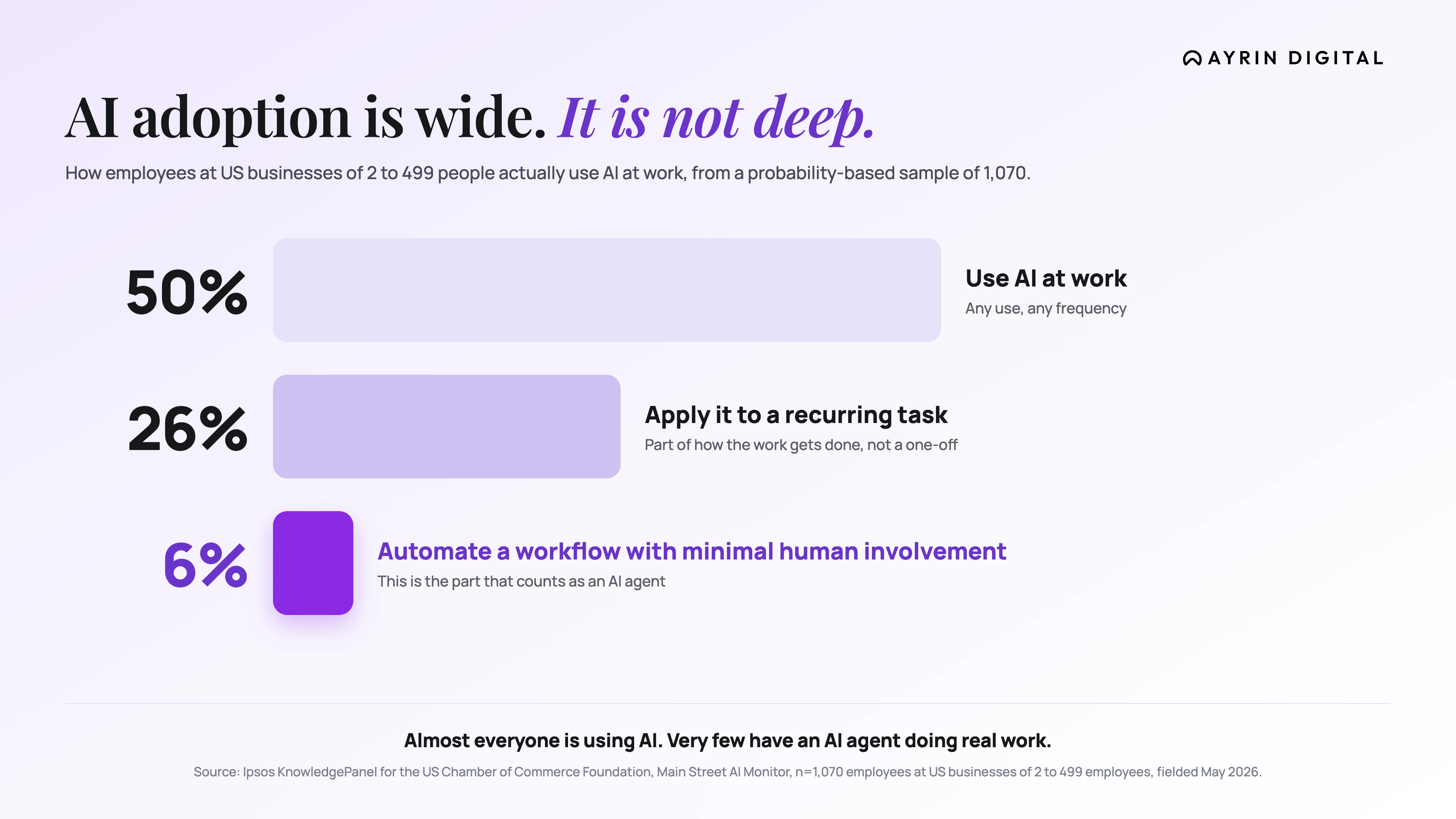
1. Adoption is wide and shallow. Half of small-business employees use AI at work. Two thirds of that use is personal productivity, drafting and summarizing and brainstorming. Only 6% use AI to automate a workflow with minimal human involvement, which is the functional definition of an agent. That data comes from an Ipsos KnowledgePanel survey of 1,070 workers at US businesses of 2 to 499 employees, fielded May 2026. It is a probability-based sample, not an opt-in panel, which is why we trust it over the higher numbers.
2. In the mid-market, the blocker is readiness, not appetite. Grant Thornton surveyed 950 US senior business leaders in early 2026 and found that 70% of midmarket companies, defined as $100M to $1B in revenue, say at least half their core applications are not AI-ready. Only 14% have a formal AI strategy actually running in operations. Their word for the segment was "disproportionately concentrated in the piloting phase."
3. Be careful which adoption number you repeat. Advisory and vendor surveys put mid-market AI adoption at 86% to 91%. The Census puts firms of 100 to 249 employees at 32%. Both are accurate for what they measured. The high numbers come from executive panels that screened for AI users before asking whether they use AI. If you are benchmarking yourself against 90%, you are benchmarking against a sample you may not belong to.
Our read, as an applied AI product and engineering firm
The 6% figure is not a sign that smaller teams are behind. It is a sign that almost nobody has done the integration work yet, and integration is the part that has to happen before an agent can do anything real. A ten-person product team with one clean system to connect to is closer to a working AI agent than a mid-market company with nine systems and 70% of them not ready.
Sources
- Anthropic and Material. The 2026 State of AI Agents Report.
- OpenAI. A Practical Guide to Building Agents.
- Clutch. Software Development Company Pricing Guide.
- US Chamber of Commerce Foundation and Ipsos. Main Street AI Monitor. Fielded May 2026, n=1,070 employees at US businesses of 2 to 499 employees.
- Grant Thornton. 2026 AI Impact Survey. Fielded February to March 2026, n=950 US senior business leaders.
- RSM US. Middle Market AI Survey 2026. Fielded March 2026, n=1,030.
- US Census Bureau. Business Trends and Outlook Survey, AI supplement. May 2026.
Conclusion: Build the AI agent your business actually needs, and not what is trending
One of our recent projects with FiveForty is a classic case of what effective picking of an AI agent use case looks like. The scope at this pace was small on purpose. They are an ERP consultancy running Dynamics 365 deployments across dozens of countries, and they had eight years of project data nobody could get an answer out of. Preparing the weekly status report was eating most of the week.
The AI agent we built sits on those eight years of specs, emails and project discussions, and puts the relevant history in front of a consultant while they are working a ticket, in English or French. Three to four hours back per person per day, and decisions made twice as fast.
Their CEO was clear that automating the consultants was never the point. He wanted them able to do something they could not do before, which was to use years of their own valuable learning and insights while making a call on a project.
If you're evaluating whether an AI agent is the right call for a given process, or what a realistic first build would cost for your systems, let’s talk.