



- "Build vs. buy" is the wrong question! There is a third option called blend, a technique that uses a vendor's model but the data remains your own, that 29–32% of organizations are already on.
- The right choice between buy, build and blend depends on six factors: strategic differentiation, data advantage, time-to-value, operating model maturity, cost profile, and vendor risk.
- Vendor lock-in is the risk most companies don't budget for, and it applies to blend deals as much as buy deals, so exit terms and vendor viability need to be checked either way.
- Cost estimates vary by 10x+ depending on the source, so don't anchor on one number instead price both build and buy on the same multi-year horizon and factor in the line item each side hides (customization overruns on buy, maintenance/talent on build).
- Before committing to any path, run a small, time-boxed proof on one real workflow first. That's what makes the decision defensible, not a scorecard alone.
Custom AI development means building AI software designed specifically for your workflows, your data, and your systems, instead of adapting your process to fit a generic tool. But "build vs. buy" is the wrong frame for this decision on its own. Our research spanning MIT research to enterprise surveys, all converge on the same point: There's a third option. It is usually called blend, boost, or hybrid depending on who's writing, and for most organizations it's the default. This guide treats build, buy, and blend as three equally real paths throughout.
What is custom AI development and how is it different from buying or blending?
Custom AI development is software built specifically for your needs, as opposed to an off-the-shelf tool that serves the same features to every customer. In practice, this covers AI agents that handle support or document processing, custom chatbots trained on a company's database, process automation connected to existing ERP or CRM systems, and internal tools like AI-powered search or recommendation engines.
The distinction matters because it changes who owns the risk. Buying shifts operational responsibility, such as uptime, security patching, and model updates, to a vendor; building keeps that responsibility in-house permanently; blending splits the difference, a vendor still owns the underlying model, but you own how it's used, validated, and governed.
Build, buy, or blend: What are organizations doing today?
Three separate surveys asked companies which path they're actually on, and got noticeably different splits, which is itself worth noting rather than smoothing over:
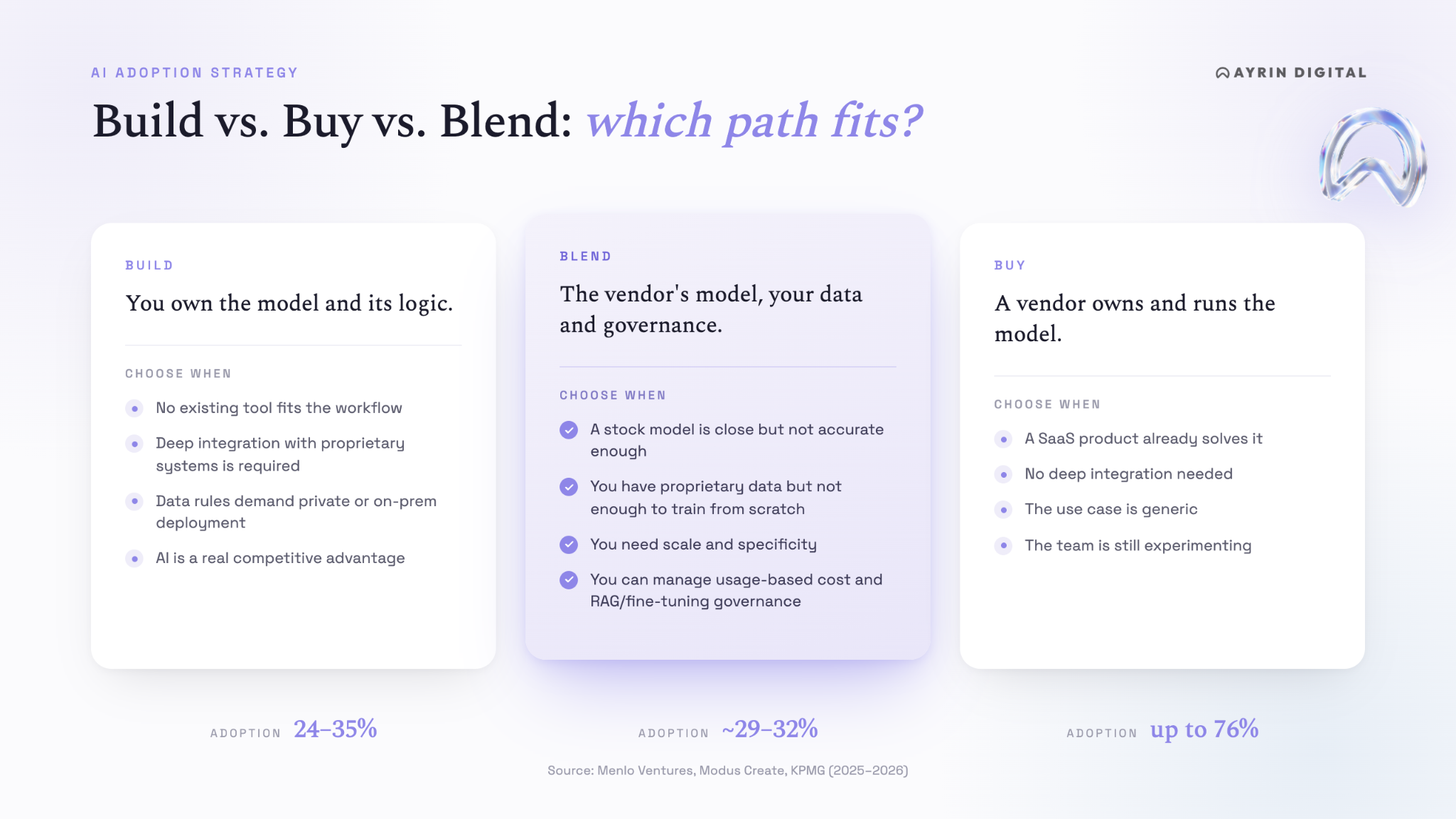
Our read on why these differ so much: Menlo Ventures' survey asked about purchased vs. built AI use cases without a blend option on the table, which likely pushes respondents who are actually blending toward whichever of the two remaining labels feels closest. Modus Create and KPMG, which offered blend/mix as an explicit third choice, both land it at roughly 29–32%, a meaningfully large category either way.
Modus Create goes further and argues the true build number in any of these surveys is probably inflated, because much of what respondents call "building" is really integrating and prompt-tuning around a third-party model's core intelligence, which is blending by their own definition, a point MIT's research independently supports, noting that full from-scratch building is so expensive and difficult that many companies who intend to build actually end up fine-tuning or adapting open-source foundation models instead, which is boosting/blending in every other framework's terms.
When should you build?
Building gives the most control and differentiation, but it's genuinely expensive and difficult, which is exactly why so many companies default to boosting or fine-tuning instead of building from scratch. But if some of the following factors apply to you, you may consider building:
- The workflow doesn't fit any existing tool without heavy compromise
- Deep integration with proprietary systems or data is required
- Data privacy rules require on-premise or private deployment
- If off-the-shelf tools solve most of the problem but miss the critical remainder
- If AI is a genuine, "industry-native" competitive advantage, not a convenience feature
When should you buy?
Buying is usually the safer and faster path when the capability is commoditized. Buying is recommended when any of the following is applicable:
- The SaaS product already solves the exact problem
- Deep integration isn't needed
- The use case is generic
- The team is still experimenting
MIT's research frames buying as "the fast path to market": the vendor provides, runs, and maintains the model, pricing is usage-based, and the model is often tuned to a narrow context such as a specific business function. According to the study by Menlo Ventures, 76% of AI use cases were purchased rather than built in 2025, up from 53% in 2024.
When should you blend?
Blend when the underlying intelligence doesn't need to be proprietary but how it's applied does.
Consider blending when:
- A vendor's stock model is close to solving your problem but not accurate enough for your specific context
- You have valuable proprietary data, but not enough volume or diversity to justify training a full model from scratch
- The problem requires both scale and specificity
- You can tolerate ongoing, usage-based costs and can commit to the data governance and validation processes that fine-tuning or RAG require.
KPMG's data suggests this is already the most common real-world pattern after buying outright: 29% of organizations in its survey reported a mix of building, buying, and partnering, versus only 12% building alone.
A framework for build, buy, or blend decision
The table below is our synthesis across multiple independently developed scoring approaches, extended to a three-way build/buy/blend comparison:
No single criterion is disqualifying on its own, but four or more signals in one column is a strong indicator. If an organization scores high on differentiation and data advantage but low on operating model maturity, the answer isn't automatically buy, it may be build with guardrails, or blend while the operating model catches up.
The vendor lock-in risk nobody budgets for (build, buy, or blend)
A Zapier survey of enterprise leaders found that
- nearly three in four respondents said losing their primary AI vendor would negatively affect day-to-day operations
- Only 6% said they could walk away without disruption
- More than a third are concerned about a single point of failure in their AI vendor relationships
- 32% specifically worry about a vendor shutting down entirely
- 44% of enterprises now use multiple AI vendors simultaneously to spread that risk
- 42% maintain contingency plans for pricing changes or outages.
MIT's research flags the same exposure specifically for blended approaches: if a vendor discontinues a model version or pushes a major update, organizations may suddenly need to rework processes or offerings built on top of it.
Zapier's Emily Mabie frames the practical questions to ask before signing: "Who actually owns the vendor relationship? If the service starts slipping, what's the exit plan?". A practical recommendation is to treat vendors as strategic collaborators rather than pure suppliers, which gives you more visibility into roadmap changes before they hit your production system. In scorecard terms, this argues for adding vendor viability and model-change notice terms as an explicit line item for blend deals specifically, not just pure buy deals.
How much does custom AI development cost, and how long does it take?
Cost figures in this space vary widely depending on whether you're looking at one agency's stated rates or aggregated marketplace data. A Forbes Technology Council member and CEO of an enterprise AI company described a client who bought an off-the-shelf solution and then spent more money customizing it than building from scratch would have cost, and separately, a fintech client that started by buying but later built in-house because it needed deeper security controls than the vendor offered.
What we would recommend is to price both paths on a fixed time horizon (keeping in line the timelines) and put a real number against the specific line item each side tends to hide. Compare total long-term costs, not just the upfront price. Buying can become expensive when you need custom integrations whereas building costs more later for the engineers who maintain it. Choose the option whose ongoing and future costs end up higher for your specific use case, not the one that looks cheapest on day one.
This is also where the choice of partner shows up in the math. We're tech-agnostic on purpose: we pick the stack that fits your problem, not the one we're biased toward, so you're not paying a premium for someone else's partnership deal. And we build software you own outright, with no engineered dependencies designed to keep you paying. The goal is genuine value, not a lock-in trap that turns a one-time build into a permanent line item.
Common mistakes in the build vs. buy vs. blend decision
Some mistakes organizations generally tend to make are:
- Assuming AI is all that is needed: CGI's Gaby Martin describes a government agency that wanted AI to reconcile two mismatched datasets; the actual fix was two daily SQL queries, no AI required. The lesson is to solve the business problem first, then decide whether AI is actually the right tool.
- Mislabeling blend as build: As mentioned earlier, both Modus Create and MIT's research argues that much of what organizations report as "building" is basically just blending. The practical risk: if leadership thinks it's building a defensible moat when it's actually blending on top of a vendor's model, it will underinvest in exactly the vendor-risk safeguards covered above.
- Treating it as a purely technical decision: Capgemini's Darshan Naik: "One of the most common mistakes is treating build-versus-buy as a purely technology decision". In reality, the right choice depends just as much on business strategy, governance, talent, and long-term operating costs.
- Spreading effort too thin: EY's Vamsi Duvvuri describes a common failure pattern of "spreading effort too thin, touching many workflows without fully transforming any, rather than proving depth in a single end-to-end use case". Organizations typically see better results by proving value in one high-impact workflow before expanding.
- Skipping the prototype phase: Building straight to production spec without validating the approach first is how a project burns a hole in the budget. Before anyone learns whether the approach works you need to dedicate time to prototyping. A 1-2 week prototype costs a fraction of that.
- Underestimating total cost of ownership on all three paths: Companies often underestimate the true cost of every approach. Building comes with ongoing maintenance, buying involves licensing and subscription fees, and blend/boost solutions become more expensive as usage grows.
Industry trends: What's next for build vs. buy vs. blend (2026 and beyond)
- Blend keeps showing up as a distinct, sizeable category, not a footnote: As seen earlier the blend option at 29–32% which means for most companies, the practical planning question over the next few months is less "build or buy" and more "which layer do we blend, and how."
- Governance and explainability move from optional to load-bearing. Menlo Ventures predicts that explainability and governance will become standard as AI agents take on more responsibility. Organizations will need clear audit logs and explanations for AI decisions, and TechTarget notes that building governance from the start leads to better compliance and adoption.
- Continuous evaluation replaces the one-time decision. Capgemini's Darshan Naik notes that AI technologies and vendor capabilities are evolving quickly enough that a strong build decision today may have a better alternative within a year, and recommends treating build-vs-buy-vs-blend as an ongoing architecture discipline with periodic vendor review, not a single procurement event.
- Net AI spend keeps rising even as inference gets cheaper. Menlo Ventures frames this as Jevons paradox holding for AI: falling per-unit inference costs are not reducing total spend, because usage volume and willingness to pay for frontier performance are rising faster than costs fall. This compounds the blend cost-creep problem noted in the framework table above: usage-based costs for a boosted/blended system are worth re-checking annually, not treated as fixed at the time of the original decision.
How to Start: A Practical Next Step
Our recommendation is to run a small, time-boxed proof before committing to build, buy, or blend. Scope one workflow slice, one real integration, one measurable outcome, and a deliberate look at what happens when the AI is wrong or uncertain. That evidence, not a scorecard alone, is what makes a recommendation defensible to finance, security, and the rest of the leadership team, and it's also the point at which vendor viability and exit terms should be checked, for a blend deal as much as a buy deal.