


Last week I wrote here that AI is cutting the output layer of the work, not the work itself. The mechanical part, turning a clear spec into code, turning a brief into a first draft, is getting cheaper by the month. The judgment sitting on top of it is getting scarcer, and more valuable.
I argued it from what we see on the delivery side at my applied AI firm. We engineer AI-native software for other companies, so we feel these shifts in the actual work months before they turn into a take online.
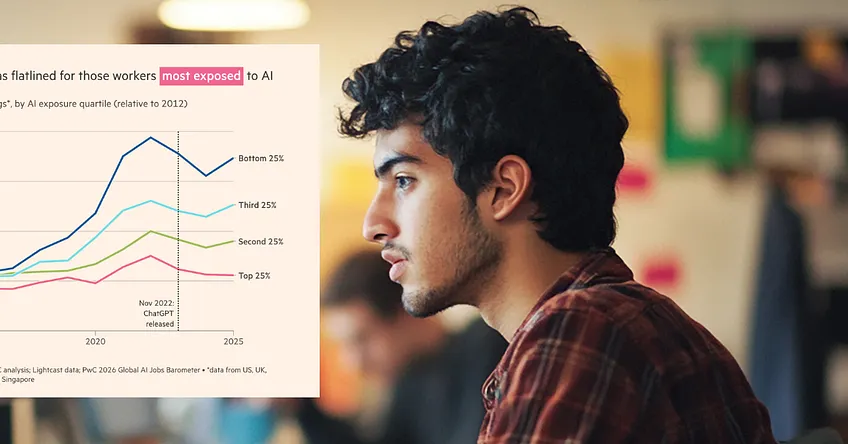
Three days later the Financial Times published the numbers. And the number was bigger than I would have guessed.
The floor is rising for entry level, and now there’s a number on it
Andrew Hill’s piece pointed to PwC’s analysis of more than a billion job ads across six continents. Entry-level postings now ask for 35% more senior-level skills than they did in 2019.
Essentially, the entry-level job still exists, but the primary blank state of experience/knowledge that made it “entry-level” is what’s gone.
The tasks that used to be how you got in the door are the same tasks AI can do in minutes. So naturally businesses have stopped hiring people to do those tasks, and started hiring for human judgment to validate whether the machine’s version is any good.
That is traditionally a senior level skill, and businesses are asking for it at the door now. In my opinion that’s the real change, not the layoffs-versus-hiring argument everyone keeps having.
The doomsday view of the job market is not right, even if the layoff trend is real
Let me be clear, the layoffs are real. Tech has cut in waves for two years, initially cautiously, and now more openly, often pinning the decision on a move to AI. But a lot of it isn’t really about AI. Plenty of it is companies correcting the excesses of Covid-era hiring, when everyone staffed up for a boom that didn’t hold, and AI has become the convenient excuse. Either way, they’re recalibrating in the open: trimming headcount, flattening the middle, moving budget toward fewer, more senior people.
For instance, Salesforce cut close to a thousand roles twice in the last year.
And yet the same Salesforce is now hiring 1,000 grads and interns more than last year, to build its AI products, and acquiring AI companies like Pokémons, consequently adding more heads to their workforce.
US firms overall expect to bring on 5.6% more college grads this year, per NACE. And the firms making the biggest AI bets grew headcount by about 10% after adopting it, with entry-level roles up 12%, per Ramp and Revelio Labs.
That said, I’d read that data cautiously. It’s correlation, not proof: the heavy adopters were already bigger, faster-growing, more technical firms, and the gains cluster in tech-heavy sectors. So the right read isn’t a verdict either way. The work is being repriced, in headcount, in seniority, and in what a company will pay for.
As Aneesh Raman, LinkedIn’s Chief Economic Opportunity Officer, put it: early-career work is moving from grunt work to real work.
But the grunt work had a role to play in skill development
The grunt work is never only grunt work. It is how experience and pattern recognition gets built, and through it comes judgement.
You pull a thousand boring reports and you slowly learn to feel when a number is wrong. You write a hundred mediocre drafts and you learn what a good one is. Nobody teaches that in a course or a workshop. It comes from the reps, the same way you only build muscle with resistance training.
There is an expected but short-sighted trend that has taken shape. Businesses are removing the reps and hiring for the instinct those reps used to produce. For now that works, because the market is full of senior people who got their reps before AI. That supply is there for now, but it’s also finite. So the question to ask here is: if nothing changes, where does that judgment come from 10 or 20 years from now?
An interesting comment I got on my last article was:
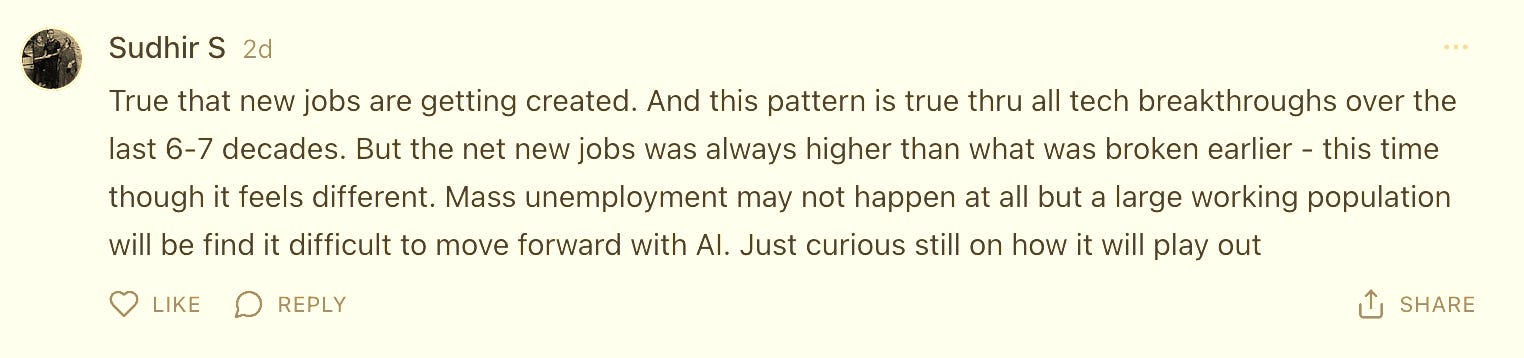
I think Sudhir here is right to feel this, and I don’t think it’s about the final headcount. It’s about the speed. The skill the market wants is moving faster than most people can retrain or grow into it. This is resulting in a large group of mid-career folks to not find that jump easy, even if mass unemployment never arrives. That’s the real cost to watch.
A lot of the world’s engineering talent, ours included, learned the craft by doing foundational work in volume, the kind that was cheap to hand out and forgiving to get wrong the first few times. Make that layer redundant and you haven’t just changed a job description, you’ve changed how a generation learns the trade.
So what do we actually do
If you’re building a team right now, the useful questions aren’t about headcount. As I see it there are three:
- Which of your “junior” tasks are actually judgment calls wearing a junior title? Hire and pay for those honestly, don’t pretend they’re entry-level.
- Where will your young hires get their reps and build their judgement muscle? If the machine does the formative work now, you have to hand them the hard, ambiguous problems on purpose, early, even when it runs slower.
- Are you willing to pay for that learning? It used to be a free byproduct of the work, and the progression of talent and learning was more or less linear. It isn’t anymore.
Another thought-provoking question I got last week was:
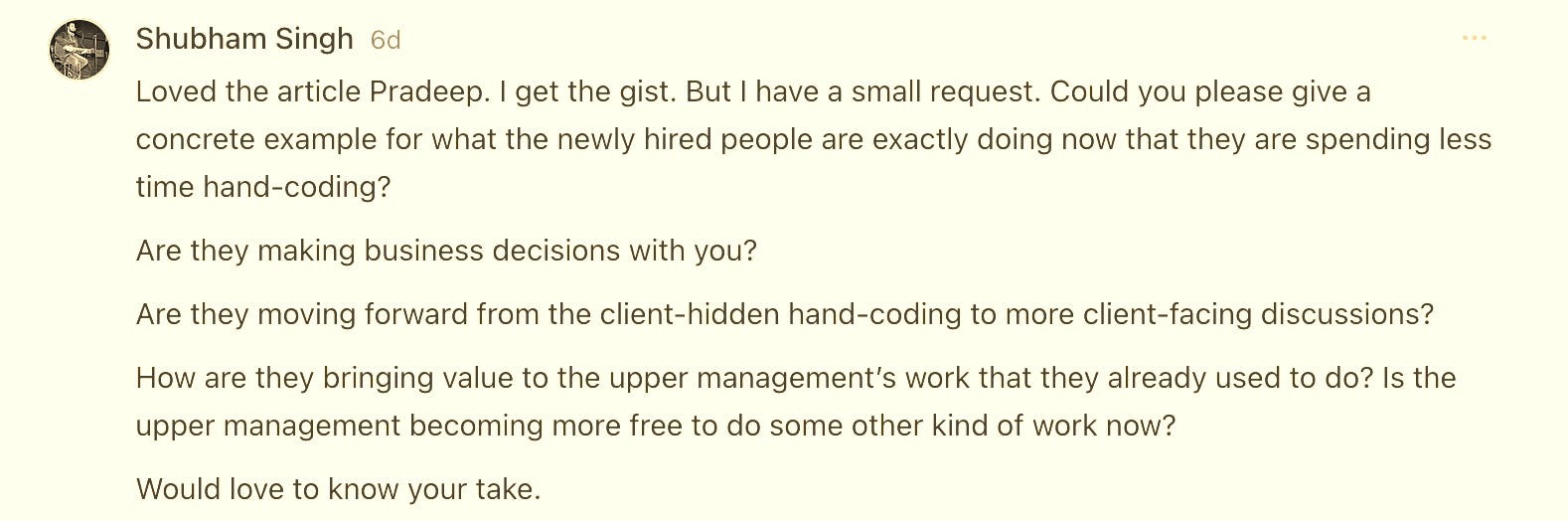
Shubham asked the fair version of what everyone’s thinking: if the new hires are hand-coding less, what are they actually doing, and what does it do to the people above them?
I don’t think AI reduces the work for the senior folks at all. If anything, each round of senior folks ends up casting a wider net for context and judgment, and starts asking what else can be done, what to optimize, what to build next. The work moves from just doing, to strategy, to innovation.
Because AI can be trained on what has already happened. It’s good, sometimes scarily good, at what already exists. But invention and innovation still sit squarely in the human purview.
Originally posted on "Wide Angle by Pradeep Nalluri" on July 14, 2026.