



- An AI strategy is a sequencing decision: which use cases to pursue, in what order, and what must be true before each one scales.
- Nearly nine in ten companies in McKinsey's 2026 survey use AI regularly, yet only about 6% attribute significant EBIT impact to it.
- The gap is organizational: pilots stall when nobody redesigns the workflow, names an owner, or picks the metric that proves value.
- Ayrin's four-stage roadmap moves through readiness, prioritization, build and integrate, then scale and govern, with a named owner per stage.
- A five-person team or a single repetitive task needs one scoped automation project, not a full enterprise AI strategy.
What is an AI strategy?
An AI strategy is a sequencing plan: which business problems AI will address, in what order, and what data, governance, and technical foundation has to exist before each one can move from pilot to production. It is a ranked list of use cases with a path to production, which makes it different from a list of tools to buy or a mission statement about becoming "AI-native."
Most companies already have plenty of AI activity without a strategy. McKinsey's 2026 State of AI survey of 1,719 respondents in 97 countries found nearly nine in ten report regular AI use in at least one business function. Activity at that level is common. A sequence that compounds is rare.
A useful test for any use case on the list is what it makes possible. When we started work with FiveForty, a Microsoft Dynamics 365 and ERP consulting firm, its CEO Jonathan Lascaux was clear that the goal was never to automate his consultants. He wanted the firm to do things it could not do before, such as answering a client's question by drawing on eight years of past tickets. That framing changed which use case went first. Ayrin's view is that a strategy built only around cost-cutting automation tends to pick the smallest wins and stall there.
What's the difference between an AI strategy and an AI roadmap?
Strategy answers what and why; roadmap answers how and when. Treating them as the same thing is a common reason AI work stalls before production.
| Dimension | AI strategy | AI roadmap |
|---|---|---|
| Question it answers | Which problems should AI solve, and why these first? | In what order do we build, and who owns each step? |
| Output | A ranked list of use cases with the outcome each should produce | A staged plan with owners, gates, and a metric per use case |
| Fails when | It has no path to execution | It executes the wrong project efficiently |
| Owned by | Leadership with the business units that will use it | A named owner per stage (see below) |
Ayrin's four-stage framework holds both at once: each stage forces a strategic decision, then hands off to the roadmap step that executes it.
Why most AI initiatives stall before delivering value
Most AI initiatives stall because the pilot was never redesigned into the workflow around it. Two of the largest 2026 surveys show the same gap between adoption and value.
- McKinsey (May to June 2026): 37% of respondents attribute at least some EBIT impact to AI. Only about 6% qualify as high performers, meaning 5% or more of EBIT comes from AI and they call the impact significant. Nearly three-quarters of those high performers fundamentally redesigned workflows around AI (McKinsey).
- BCG (July 2026): in a survey of 152 CEOs at companies with $500 million or more in revenue, more than half named linking AI to the P&L as a key barrier, yet only 14% have defined P&L impact for all their AI initiatives. Nearly two-thirds run AI pilots; only 26% have embedded AI in a broader business transformation (BCG).
BCG's sample skews toward large enterprises, but the pattern matches what we see with founder-led and mid-market teams. BCG's Nicolas De Bellefonds put it plainly: "the potential is larger, but so is the penalty for weak execution."
Our read on both surveys and our own projects is that tool selection is rarely the constraint. Pilots stall at three points: the workflow around the tool stays the same, the data turns out not to be ready, or no one owns the decision to scale. The four stages below are built to catch each one early.
Who should own an AI strategy?
Ownership works best split by stage, with the person who decides to scale a use case kept separate from the person who championed it. One executive who both funds a use case and judges whether it worked removes the check that would have stopped it at Stage 2.
| Stage | Natural owner | Why |
|---|---|---|
| 1. Readiness | IT or data leadership | They already own the data, systems, and security posture |
| 2. Prioritization | A small cross-functional group | Ranking by value needs the business units that will use each tool |
| 3. Build and integrate | Engineering lead or the build partner | They own delivery and integration into existing systems |
| 4. Scale and govern | A named risk or operations owner | Someone who did not champion the use case decides whether it scales |
The CEO's job is to make sure each stage has a named owner and that handoffs happen on schedule.
The outside check matters even with a build partner involved. When Hay House explained why it chose Ayrin, the reason was a partner who could strategize with the team and challenge its ideas as well as build. In our experience, the most useful thing a partner does in Stage 2 is say no to a use case early.
What does a working AI roadmap look like?
Ayrin's four-stage roadmap walks each use case through readiness, prioritization, build, and governance, in that order. Jumping straight to a pilot is the pattern behind most of the stalled projects in the surveys above.
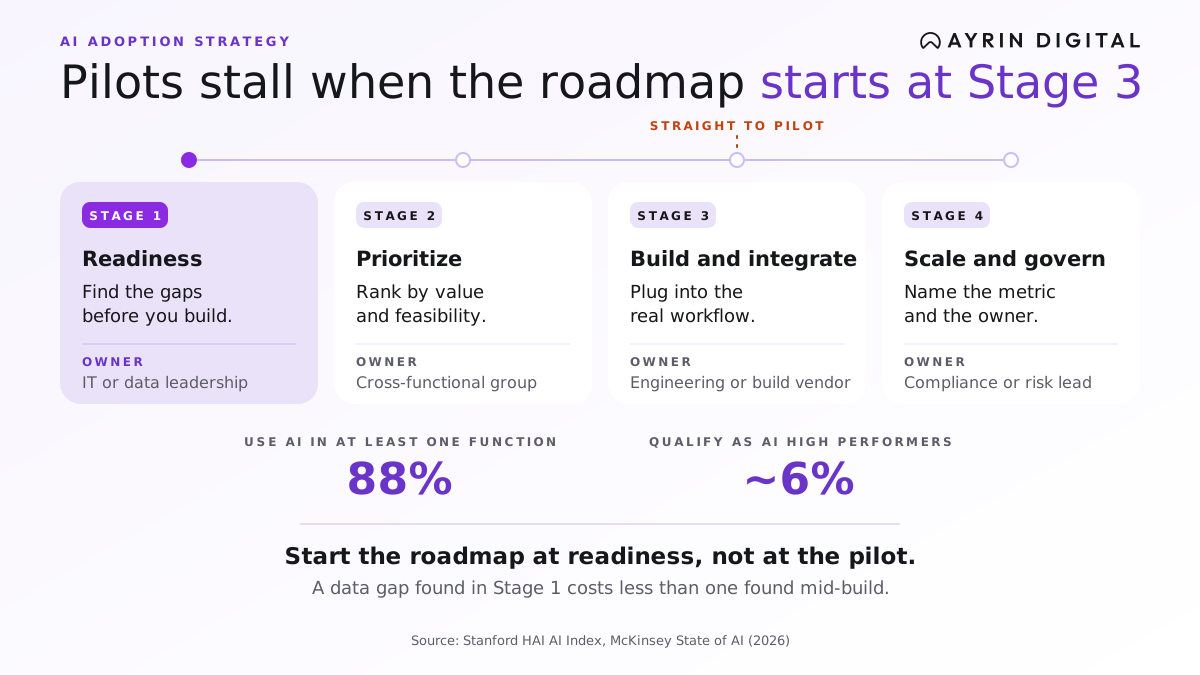
Stage 1: readiness assessment
Before any use case is picked, answer three questions: what data exists and in what condition, what governance and risk posture the company will operate under, and which systems a new AI capability must plug into. Finding a data gap here costs days. Finding it after a system is built costs a rebuild.
Readiness also surfaces assets teams forget they have. FiveForty had eight years of support tickets sitting in Azure DevOps, unused. That history became the base of the system we built: when a new ticket arrives, consultants see similar past issues, the related documents, and the threads where they were solved (see how it works).
Stage 2: use-case prioritization and sequencing
Rank candidates on two axes: the business value at stake and how feasible the use case is given Stage 1's findings. High-value, high-feasibility use cases go first because an early, measurable win builds the internal case for the next one. Sequencing, more than ambition, is what separates a roadmap from a wish list.
Stage 3: build and integrate
This is where the plan becomes a working system: custom platforms and applications around the prioritized use cases, agents and automation layered onto real workflows, and the data pipelines that connect them to the systems already in use. A tool that plugs into existing operations gets adopted. A parallel tool that people have to remember to open usually doesn't.
Stage 4: scale, govern, and measure
A system that works for one team has to be extended deliberately. This stage sets the governance, security, and compliance guardrails, and names the metric each use case is measured against before it moves past the pilot. Without a named metric and a named owner, a use case tends to stay a pilot indefinitely.
Our view is that the first metric for a new internal AI tool should be the simplest proof that people use it. ROI follows usage, and a tool nobody opens has no ROI to measure.
Should you start with a pilot or a platform?
Start with a pilot when you are testing appetite or your data is scattered; start with a platform when several related use cases already share the same data. Most companies default to pilot-first because it feels lower-risk, and that default is often right, until it isn't.
| Dimension | Pilot-first | Platform-first |
|---|---|---|
| Starting point | One narrow use case with a clear owner | A shared data and integration layer that supports several use cases |
| What changes | One workflow is redesigned | Several workflows across a function are redesigned together |
| Cost and effort | Lower upfront; needs discipline to avoid staying a pilot | Higher upfront investment in data integration and governance |
| Best fit | Testing internal appetite, or limited data infrastructure | Related use cases identified and Stage 1 complete |
| Ayrin example | FiveForty: one use case, ticket resolution, built on existing ticket history | SupraHuman: eight coaching and wearable-data apps consolidated into one platform |
The common mistake is choosing pilot-first by default and never revisiting it once three or four disconnected pilots have piled up with no shared data layer underneath. SupraHuman came to us at that point: coaching tools and wearable data were spread across eight separate apps. Consolidating them made weekly coaching decisions 70% faster, by the client's own measure (Ayrin case studies).
How much does an AI roadmap cost, and how long does it take?
A Stage 1 readiness assessment is the smallest piece of work, measured in weeks, and a single well-scoped use case can show results within the first 60 days. Platform-first builds take longer because they bundle several builds together. Anyone who quotes one number before hearing your use cases is guessing.
As a scoping guide:
| Scope | What you get | Relative time and cost |
|---|---|---|
| Stage 1 readiness assessment, one business unit | A ranked list of use cases and a plan for closing data gaps | Smallest. A fixed piece of work measured in weeks |
| One use case built into an existing workflow (pilot-first) | One working tool inside a workflow your team already uses | Moderate. Most clients see results within the first 60 days |
| Shared platform supporting several use cases (platform-first) | A shared data layer, governance and access controls that several use cases run on | Largest. Measured in months, with the shared data layer paid for upfront |
What makes a project cost more or less:
- Data condition. Clean, reachable data in one system costs far less than data spread across tools, which first has to be joined and permissioned.
- Number of integrations. Each system the AI must read from or write to (ERP, CRM, ticketing) adds build and testing time.
- Accuracy bar. A tool whose outputs go to clients unchecked needs more evaluation and review tooling than an internal assistant.
- Compliance scope. Regulated data (health, finance, children’s data) adds governance work in Stage 4.
- Pilot-first or platform-first. A platform carries the cost of the shared data layer upfront.
Two things reliably push a roadmap over budget: skipping Stage 1 and finding the data gap mid-build, and choosing platform-first without the readiness to justify it. A quote far below the range usually means something was scoped out, often Stage 1 or the integration work.
What a good AI strategy document actually includes
A usable AI strategy document is short enough to act on and answers five things. If it misses any of them, it is a vision statement.
- The two or three use cases prioritized first, and why they ranked above the rest.
- The readiness gaps found in Stage 1, each with an owner assigned to close it.
- The metric each use case is measured against before it counts as a success (at FiveForty, daily usage).
- Who owns the decision to scale, pause, or stop each use case.
- The governance and security requirements a system must meet before it reaches production.
When not to lead with a full enterprise AI strategy
A full roadmapping exercise is the wrong first move in three cases. This is Ayrin's own guidance from scoping calls.
- A team of a handful of people. A five-person startup needs one well-scoped automation, solved directly.
- One well-defined tactical need. If the problem is one repetitive task in one team, a scoped automation project answers it faster and cheaper than an enterprise-wide readiness assessment.
- A company mid-migration. If you are partway through replacing an ERP or CRM, finish that migration before layering an AI roadmap onto the same technical staff and budget. Running both at once tends to slow both down.